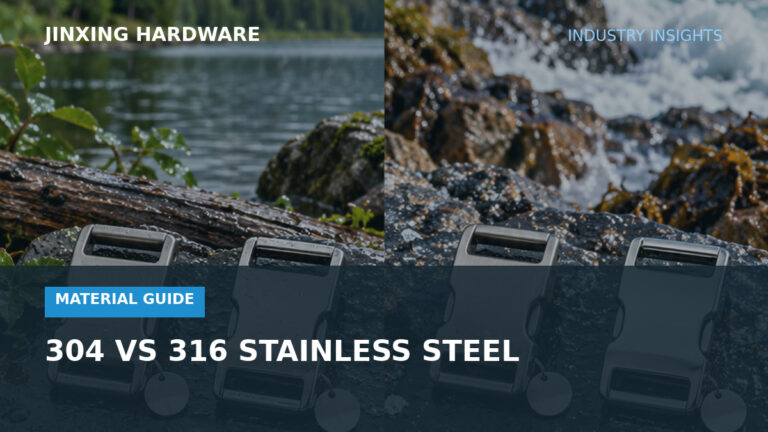
304 and 316 stainless steel are both widely used, but “marine grade”
should not replace an application review. The correct choice depends on
chloride exposure, temperature, crevices, cleaning chemicals,
fabrication, finish, strength requirements and budget.
Grade 304 is the most widely used austenitic stainless steel and
offers good forming, welding and corrosion resistance in many
atmospheric environments. Grade 316 contains molybdenum and generally
provides better resistance to pitting and crevice corrosion in chloride
environments.
Practical comparison
| Selection factor | 304 stainless steel | 316 stainless steel |
|---|---|---|
| General outdoor use | Often suitable when exposure is moderate and maintenance is possible | Also suitable, usually at higher material cost |
| Coastal salt air | May require closer review and cleaning | Commonly preferred because of improved chloride resistance |
| Warm chloride exposure | Pitting and crevice risk increases | Better than 304, but not immune |
| Fabrication | Excellent forming and welding availability | Excellent fabrication, with material availability to confirm |
| Appearance | Polished, brushed or tumbled finishes available | Similar finish options |
| Cost | Usually lower | Usually higher |
“Marine grade” does
not mean corrosion-proof
Worldstainless and industry grade data describe 316 as having higher
pitting and crevice-corrosion resistance in chloride environments. They
also note that 316 can still suffer corrosion in warm chloride
conditions. Deposits, tight crevices, rough surfaces and poor cleaning
can make local exposure more severe.
For pet and equestrian hardware used near the coast, consider not
only the alloy but also geometry and maintenance. Salt trapped inside a
swivel joint or under a webbing loop may create a different condition
from an open polished surface.
Confirm the actual grade
“Stainless steel” is not a complete purchase specification. State the
grade or accepted equivalent, product form, finish and any verification
method. Depending on the project, buyers may request material
certificates, supplier declarations or positive material identification
on agreed samples.
Also check whether every component uses the same grade. A snap hook
may contain a body, gate, pin, spring and swivel assembled from
different materials. The corrosion performance of the complete mechanism
can be controlled by its least suitable part.
Selection questions for an
RFQ
- Will the product be used indoors, outdoors, near the coast or in
direct saltwater contact? - Will sweat, urine, cleaning chemicals or mud remain on the
hardware? - Are there crevices, springs, welded areas or joints that retain
moisture? - What cleaning and maintenance can the end user realistically
perform? - Is appearance, mechanical performance or corrosion resistance the
primary driver? - Is grade verification required, and by which document or test?
- Must every subcomponent meet the same material specification?
Match grade selection
with validation
Material grade is one input, not the entire validation plan. Use
appropriate corrosion testing, functional testing and field trials for
the actual product. Avoid comparing two alloys only by a single
salt-spray number unless the specimen and acceptance criteria reflect
the intended use.
Jinxing Hardware can evaluate standard and custom hardware in
specified materials and finishes. Buyers should provide the application,
environment, dimensions, expected tests and target quantity so the
project can be reviewed accurately.
Frequently asked questions
Is 316 always better than 304?
316 generally offers better resistance to pitting and crevice corrosion
in chloride environments, but selection still depends on the complete
environment, fabrication and cost.
Is 316 stainless steel rust-proof?
No. It is corrosion-resistant, not corrosion-proof. Warm chlorides,
deposits, crevices and poor maintenance can still cause attack.
Can a stainless snap hook contain mixed
materials?
Yes. Bodies, pins, springs and swivel parts may differ. The buyer should
confirm the material requirement for each relevant subcomponent.
Sources
- Worldstainless, Stainless Steel Grade Datasheets: https://worldstainless.org/wp-content/uploads/2025/02/stainless-steel-grade-sheets.pdf
- Worldstainless, Corrosion Properties: https://worldstainless.org/about-stainless/properties/corrosion-properties/
- Nickel Institute, “The Nickel Advantage”: https://nickelinstitute.org/en/nickel-applications/stainless-steel/the-nickel-advantage