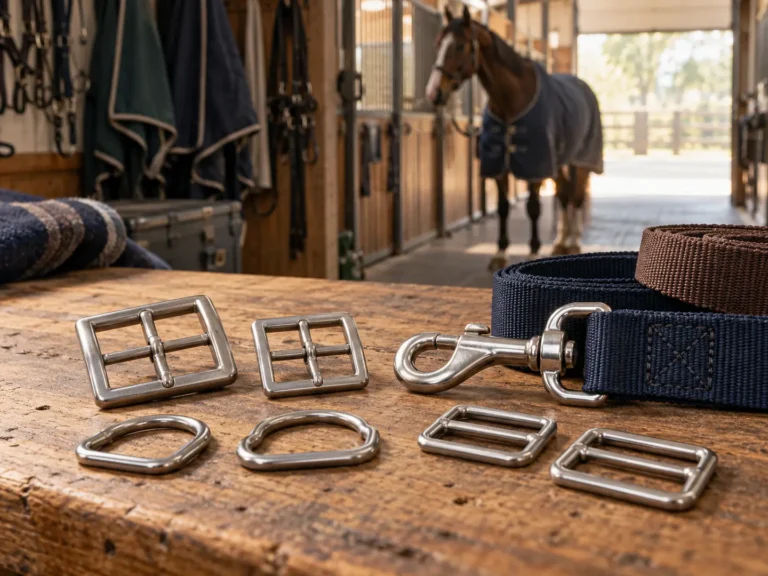
Horse blankets and rugs use several small metal components to adjust fit, connect straps and transfer load. Front buckles, D-rings, snap hooks and webbing sliders must work with the fabric, binding, webbing and stitching as one system. If one part is poorly matched, the result can be difficult adjustment, premature wear or an unreliable closure.
This guide gives equestrian brands and OEM buyers a practical way to specify horse blanket hardware without relying only on catalog names.
Quick Answer
For horse blankets, select each buckle, ring, hook and slider as part of the complete strap system. Match the internal width to the finished webbing, define the material and finish for the actual exposure, and validate the assembled blanket with fit, operation, load and corrosion tests. Using one finish across the blanket does not mean every component has the same mechanical requirement.
Quick Answer
For horse blankets, select each buckle, ring, hook and slider as part of the complete strap system. Match the internal width to the finished webbing, define the material and finish for the actual exposure, and validate the assembled blanket with fit, operation, load and corrosion tests. Using one finish across the blanket does not mean every component has the same mechanical requirement.
Horse Blanket Hardware at a Glance
| Component | Typical location | Main specification questions |
|---|---|---|
| Front buckle | Chest closure | Webbing width, tongue geometry, adjustment range and edge finish |
| D-ring or O-ring | Front, shoulder, belly or leg-strap attachment | Internal dimensions, material thickness, weld quality and pull direction |
| Snap hook | Front closure, leg strap or removable attachment | Gate opening, spring return, swivel or fixed eye and accidental contact |
| Webbing slider | Surcingle or adjustable strap | Slot width, center-bar geometry, grip and strap thickness |
| T-hook or specialized hook | Cross surcingle | Mating ring fit, rotation, retention and user operation |
1. Front Buckles
Front buckles may use a traditional tongue, a quick-connect arrangement or a buckle-and-snap combination. Whatever the style, the webbing should sit flat through the frame and the tongue should locate cleanly in the adjustment holes. The frame corners and center bar should not cut or sharply crease the strap.
Check the buckle at the loosest and tightest intended settings. A component can appear suitable on a flat sample but rotate or pull unevenly when the blanket curves around the chest. Test with the actual webbing layers, reinforcement and stitching pattern.
2. D-Rings and O-Rings
Rings provide attachment points and redirect force. D-rings offer a flat side for webbing, helping the strap sit in a defined position. O-rings allow more rotation and can suit attachments that approach from different angles.
For welded rings, inspect the weld area and its position relative to the strap and applied load. Specify internal width, internal height, material diameter or section thickness and finish. The nominal webbing width alone is not enough to define the correct ring.
3. Snap Hooks and Trigger Clips
Hooks make removable straps and closures easier to operate. A swivel-eye snap can accommodate strap movement, while a fixed rectangular eye may keep webbing aligned. The gate must open far enough for the mating ring and return fully after release.
Evaluate the gate position when the horse moves, lies down or brushes against a surface. No hardware choice eliminates the need for correct fitting, regular inspection and a complete product risk assessment. Avoid making safety claims based only on the connector name.
4. Webbing Sliders and Adjusters
A slider changes strap length and helps maintain the selected adjustment. Its performance depends on slot width, center-bar size, surface finish, webbing thickness and the direction in which the strap is threaded.
Test adjustment when the webbing is new, wet, dirty and worn to the degree relevant for the product. A slider that grips one webbing construction may slip on another. Include a threading diagram in the assembly instructions and approved production sample.
5. Match Every Component to Its Mating Part
Hardware is often selected from separate catalogs, but every connection should be evaluated as a pair. Confirm that:
- The hook gate clears the ring cross-section.
- The hook cannot jam at an unintended angle.
- The buckle tongue aligns with the strap holes.
- The slider slots accept all folded webbing layers.
- Rings have enough internal space for the strap to move without pinching.
- Metal edges do not contact or abrade the blanket fabric.
Our metal hardware size guide shows which dimensions buyers should record.
6. Material and Finish Selection
Horse blankets encounter sweat, mud, rain, dust, detergents and repeated contact. Stainless steel is often specified for corrosion resistance, while plated carbon steel can provide an effective balance of cost, strength and appearance. Zinc-alloy parts may suit detailed shapes and decorative requirements when the application and load are appropriate.
State the stainless grade or coating system instead of requesting only a silver or black color. Dark finishes can show wear at contact points, while bright finishes may vary in tone between production processes. Approve a physical reference and define which surfaces are cosmetic.
For more detail, read our surface finish selection guide.
7. Design for Inspection and Replacement
Owners should be able to inspect high-wear areas without disassembling the whole product. Position stitching and folded webbing so cracks, distortion, corrosion and gate function remain visible. Where a replaceable strap is part of the design, verify that the replacement hardware cannot be installed in the wrong orientation.
Typical warning signs include a gate that does not close, a bent frame, a cracked or open weld, deep corrosion, a sharp worn edge, excessive swivel play or webbing damage at the contact point. The brand’s care instructions should explain when the blanket or hardware should be removed from service.
8. Validation and Quality Control
Build a test plan around the intended blanket and use conditions. Consider:
- Drawing and dimensional inspection
- Assembly checks with production webbing and rings
- Repeated opening, closing and adjustment cycles
- Pull testing in the actual load direction
- Complete-assembly testing including stitching and reinforcement
- Corrosion testing under a named method with defined acceptance criteria
- Post-exposure function checks
- Packaging protection for finished surfaces
Strength requirements must specify the fixture, direction, speed, hold time, permitted deformation and failure criterion. A visual check does not establish load capacity. Use our quality inspection checklist to plan incoming and pre-shipment checks.
9. What to Put on a Horse Rug Hardware Drawing
- Component name and drawing revision
- Overall length and width
- Internal slot or ring dimensions
- Material cross-section
- Gate opening and movement requirements
- Base material and grade
- Surface finish and approved color reference
- Critical tolerances
- Test method and acceptance criteria
- Packaging and lot-identification requirements
When a standard part is not suitable, share the blanket application, sample and drawing during the custom metal hardware development process.
Frequently Asked Questions
Should all hardware on a horse blanket use the same material?
Not necessarily, but mixed materials and finishes should be reviewed for appearance, corrosion behavior, contact wear and supply consistency. Every component still needs to meet its own functional requirement.
How wide should a buckle or slider be?
The internal width should be selected from the actual finished webbing and the intended amount of clearance. Validate adjustment and grip with production-representative straps.
Does a stainless part need testing?
Yes. Material selection does not replace dimensional, functional, load and assembly testing. Stainless grade and surface condition also matter.
Technical References and Testing Notes
- ISO 9227 and ASTM B117: commonly used neutral salt-spray test methods for comparing corrosion protection. Exposure hours are laboratory comparison results and do not equal guaranteed outdoor service life.
- Dimensional approval: inspect critical openings, section thickness, gate clearance and webbing fit against the buyer-approved drawing or physical sample.
- Functional validation: use production-representative webbing and stitching with buyer-defined static and cyclic tests. There is no single universal load rating that covers every horse blanket configuration.
Technical review: Jinxing Hardware. Last updated September 22, 2026.
Technical References and Testing Notes
- ISO 9227 and ASTM B117: commonly used neutral salt-spray test methods for comparing corrosion protection. Exposure hours are laboratory comparison results and do not equal guaranteed outdoor service life.
- Dimensional approval: inspect critical openings, section thickness, gate clearance and webbing fit against the buyer-approved drawing or physical sample.
- Functional validation: use production-representative webbing and stitching with buyer-defined static and cyclic tests. There is no single universal load rating that covers every horse blanket configuration.
Technical review: Jinxing Hardware. Last updated September 22, 2026.
OEM Horse Blanket Hardware
Jinxing Hardware manufactures buckles, rings, hooks and sliders for webbing-based equestrian products. Browse our horse rug hardware, review our manufacturing capabilities, or contact us with your webbing width, drawing, finish, quantity and testing requirements.