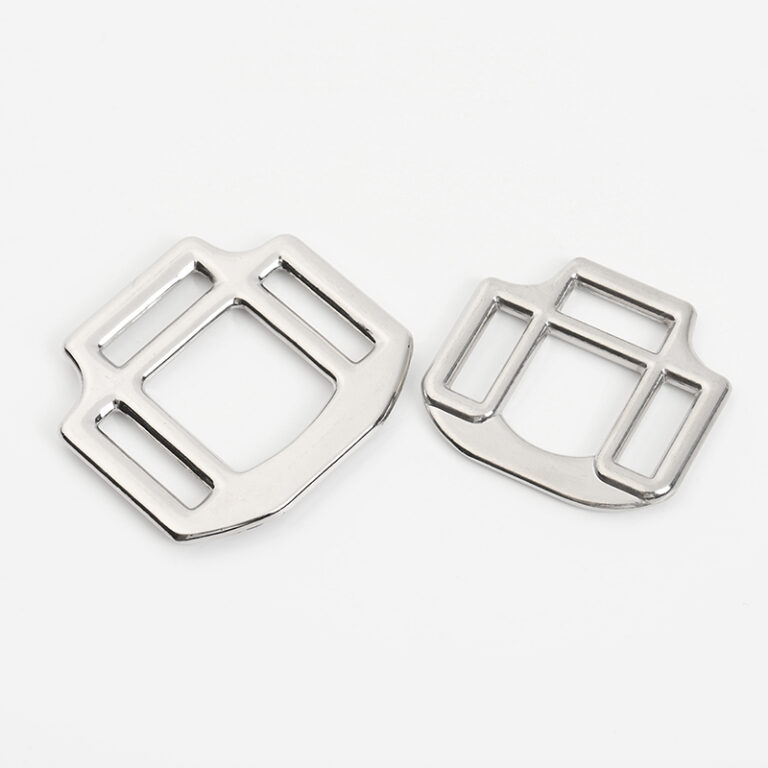
Selecting the correct hardware size requires more than checking the overall width of a buckle, hook, ring or slider. The most important measurement is usually the internal opening that connects to the webbing, strap, fabric or matching component.
This metal hardware size guide explains how to measure webbing, understand internal and external dimensions, compare different hardware types and prepare accurate specifications before ordering.
Because product structures vary, the nominal size shown in a product name should always be confirmed against the product drawing or measured sample.
Quick Answer
The nominal size of a buckle, hook or slider usually refers to the internal opening that receives the webbing, not the overall outside dimension. Measure the finished webbing width and thickness, allow only the clearance needed for movement, and approve the actual hardware with production webbing before bulk production. Ring size may refer to internal diameter, while section or wire thickness must be specified separately.
What Does the Size of Metal Hardware Mean?
For many buckles, hooks and sliders, the stated size refers to the internal width of the opening intended for webbing. It does not necessarily represent the overall external width of the component.
For example, a product described as 25 mm hardware may have a 25 mm internal webbing opening while its external width is considerably larger.
Before ordering, confirm:
- Internal webbing opening
- Overall length and width
- Material or wire thickness
- Opening or gate clearance
- Webbing thickness
- Connection method
- Required movement or adjustment
How to Measure Webbing Width
Lay the webbing flat without stretching it and measure across its full width. Use millimeters whenever possible because most hardware specifications are provided in metric dimensions.
Measure the actual webbing instead of relying only on its nominal size. Cutting, weaving, coating and edge construction can create small differences between the stated and measured width.
- Place the webbing on a flat surface.
- Remove twists and folds.
- Measure at several positions.
- Record the widest consistent measurement.
- Measure the webbing thickness separately.
Common Metric Webbing Sizes
| Metric Size | Approximate Inch Size | Selection Note |
|---|---|---|
| 10 mm | 0.39 in | Confirm the exact internal opening |
| 15 mm | 0.59 in | Check webbing thickness and edge clearance |
| 20 mm | 0.79 in | Suitable hardware varies by structure |
| 25 mm | 0.98 in | Often referred to as approximately 1 inch |
| 30 mm | 1.18 in | Do not substitute 32 mm without testing |
| 32 mm | 1.26 in | Confirm compatibility with the actual strap |
| 38 mm | 1.50 in | Commonly described as 1.5 inches |
| 40 mm | 1.57 in | Not identical to 38 mm hardware |
| 50 mm | 1.97 in | Often described as approximately 2 inches |
Inch conversions are approximate. Use the actual metric dimension shown in the product specification when checking compatibility.
Internal Width vs. External Width
The internal width determines whether the strap or webbing can pass through the hardware. External width affects available installation space and the appearance of the finished product.
Two buckles with the same internal width may have different external dimensions because of differences in frame shape, material thickness and construction.
How to Select a Metal Buckle Size
For a metal buckle, start with the actual webbing width. Then check the internal opening, frame thickness, center bar structure and the way the webbing will be threaded.
The webbing should pass through the intended opening without being excessively compressed. At the same time, an opening that is much wider than the webbing may allow unwanted side movement.
How to Select a Metal Hook Size
A hook must be checked at both connection points. Confirm the webbing opening on one side and the hook opening or gate clearance on the other side.
- Internal webbing width
- Hook opening
- Overall length
- Body width and thickness
- Swivel or rotating connection, if present
- Space required for the matching ring
A hook and ring should be tested together because their nominal sizes alone do not guarantee correct fitting or movement.
How to Select a Metal Ring Size
Ring specifications may describe the internal diameter, external diameter, wire diameter or a combination of these measurements.
- Internal diameter
- External diameter
- Wire or material diameter
- Whether the ring is welded, open or formed as another structure
How to Select a Webbing Slider Size
A slider is normally selected according to the webbing width, but webbing thickness and the slider structure also affect adjustment.
The webbing must pass through the slots according to the intended threading path. If the slots are too narrow, the strap may be difficult to assemble or adjust. If they are too large, the adjustment may not remain in the required position.
How to Match Hooks, Rings, Buckles and Sliders
When several hardware components are used in the same assembly, evaluate them as a complete system rather than selecting each part independently.
- Webbing width and hardware opening
- Webbing thickness and slot clearance
- Hook opening and ring thickness
- Ring dimensions and available movement
- Buckle structure and threading method
- Finish compatibility between connected components
- Space required for movement and assembly
Does a Larger Size Mean a Higher Load Capacity?
No. Overall size alone does not confirm load capacity.
Performance can be affected by material, thickness, structure, forming process, connection method, surface condition and the matching components used in the final assembly.
If load performance is important, provide the required test method and acceptance value before production.
Information to Provide Before Ordering
- Required hardware type
- Webbing or strap width
- Actual webbing thickness
- Internal and external dimensions
- Matching hook, ring or buckle dimensions
- Material and surface finish requirements
- Application and operating environment
- Required quantity
- Testing requirements
- Destination country
If you need a modified size or new structure, review our guide on preparing a custom metal hardware inquiry.
Frequently Asked Questions
Should a 25 mm buckle be exactly 25 mm inside?
Not always. The internal opening normally needs controlled clearance for the actual finished webbing. The drawing should state the measured internal width and its tolerance instead of relying only on a catalogue size name.
Does wider hardware always have a higher load capacity?
No. Strength also depends on material, section thickness, geometry, manufacturing method, joints and loading direction. Compare parts using an agreed test method rather than width alone.
What measurements should appear on a hardware drawing?
Show the internal opening, overall dimensions, section or wire thickness, critical radii, gate opening where applicable, tolerances, material, finish and the direction of expected load.
Technical References and Measurement Notes
- Use calibrated measuring tools appropriate to the tolerance, and record whether dimensions are taken before or after surface finishing.
- Measure flexible webbing without excessive tension and confirm both width and thickness because coating, folding and stitching can change the finished fit.
- Approve a physical sample or controlled drawing before mass production; catalogue names are not substitutes for dimensional tolerances.
Technical review: Jinxing Hardware. Last updated September 22, 2026.
Confirm the Fit Before Bulk Production
Dimensions shown online are useful for initial selection, but practical fitting with the actual webbing and matching components provides stronger confirmation.
Explore our metal hardware products, read the buyer FAQ, or contact Jinxing Hardware with your webbing dimensions and application information.
Request Help Selecting a Hardware Size