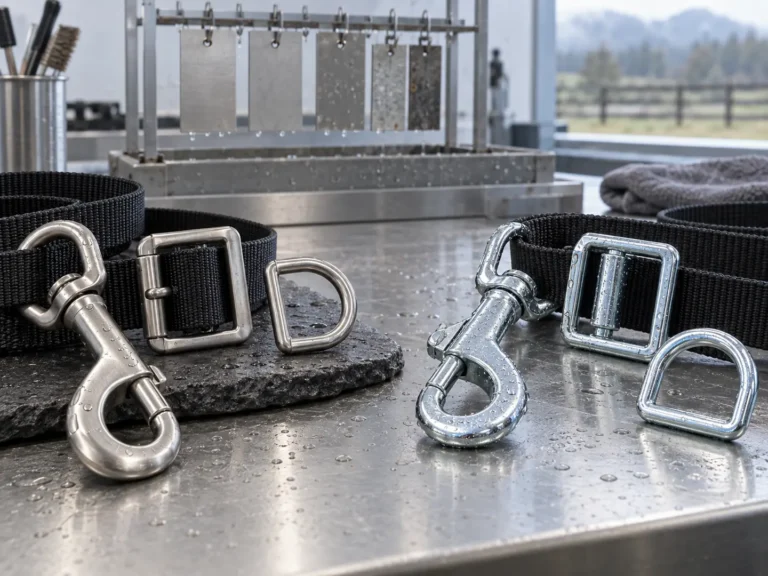
Outdoor pet and equestrian hardware is exposed to water, sweat, mud, cleaning chemicals, abrasion and repeated movement. Stainless steel and zinc-plated steel can both be appropriate, but they protect the product in different ways. Stainless steel relies on the properties of the alloy and its passive surface, while zinc-plated steel relies on a protective coating over a steel substrate.
The right choice depends on the environment, wear points, required appearance, geometry, budget and test plan. The material name alone is not a complete specification.
Quick Answer
Stainless steel is usually preferred when corrosion resistance must come from the base alloy, while zinc-plated carbon steel can be a cost-effective choice when coating specification, wear and service exposure are controlled. Neither option should be selected by colour alone. Confirm grade, coating system, geometry, moving contact, corrosion test and the complete product load requirement.
Quick Comparison
| Factor | Stainless steel | Zinc-plated steel |
|---|---|---|
| Corrosion approach | Resistance comes primarily from the alloy and passive surface | Zinc coating provides sacrificial protection to the steel substrate |
| After surface wear | No separate decorative coating is required for basic corrosion behavior | Protection can decline where plating is worn, cut or poorly covered |
| Appearance | Natural metal appearance; can be polished or brushed | Bright, clear, colored or top-coated finishes are possible |
| Cost direction | Often higher material and processing cost | Often economical for high-volume components |
| Specification priority | State the stainless grade and surface condition | State substrate, plating system, thickness or performance requirement and topcoat when applicable |
1. What Stainless Steel Means in a Hardware Specification
Stainless steel is a family of alloys, not one material. Different grades vary in corrosion resistance, formability, strength, magnetic response and cost. A purchase order that says only stainless steel leaves an important requirement undefined.
Specify the grade required by the design and verify it through supplier documentation or an agreed material test when composition is critical. Surface contamination introduced during fabrication can also affect appearance and corrosion behavior, so processing and cleaning matter alongside grade.
2. How Zinc-Plated Steel Provides Protection
Zinc plating places a zinc layer over a steel component. The coating helps protect the substrate and can be combined with passivation or a topcoat to change color and corrosion performance. It is widely used on buckles, rings, hooks and other formed components.
Coverage can be more difficult at recessed areas, threads, sharp edges and points where parts touch during finishing. Wear at moving joints or webbing contact surfaces may gradually expose the substrate. The drawing and inspection plan should identify critical areas rather than treating the whole part as visually equivalent.
3. Compare the Real Service Environment
Ask where and how the product will be used. Freshwater rain, coastal salt, stable ammonia, animal sweat, pool chemicals and detergents create different exposures. Drying time, storage and cleaning frequency also affect corrosion.
- Occasional dry outdoor use: a qualified plated-steel system may provide a practical solution.
- Frequent wet use: stainless steel may reduce dependence on an intact coating, subject to grade and design.
- Coastal or chloride exposure: material grade, crevices, cleaning and drainage need special attention.
- High-abrasion contact: test the exact finish where webbing, rings and moving gates rub.
These are selection directions, not automatic approvals. Validate the finished component under the expected conditions.
4. Corrosion Resistance Is Not the Same as Strength
A material can resist corrosion yet still be unsuitable for the required load or geometry. Strength depends on alloy, condition, cross-section, forming, welding, heat treatment and assembly. Plating can improve corrosion behavior but does not convert an undersized design into a suitable load-bearing part.
Define mechanical requirements separately. State the fixture, load direction, rate, hold time, permitted deformation and failure criterion. Test the actual production design, not only a material coupon.
5. Appearance and Color
Stainless steel is often supplied with a natural polished, tumbled or brushed appearance. Zinc-plated steel can provide bright silver and other tones through passivation and topcoats. If appearance is important, approve a physical master sample and define the viewing surface, lighting and permitted variation.
Do not choose a material from color alone. Different substrates and finishes can look similar in a product photo but perform differently. Read our surface finish guide for specification details.
6. Wear, Crevices and Moving Parts
Hooks, sliders and buckles contain contact points where metal rubs against metal or webbing. Dirt trapped in a crevice can retain moisture, and a moving gate can wear a coating locally. Review these zones during design and after cycle testing.
Useful design questions include:
- Can water drain from recessed areas?
- Will two finished parts rub during operation?
- Does webbing repeatedly polish the same edge?
- Are welds, cut edges and internal slots fully accessible to finishing?
- Can the user rinse and dry the hardware?
7. Cost and Total Product Value
Zinc-plated steel often offers an attractive piece-price direction for volume production. Stainless steel may justify its higher initial cost in products that face frequent moisture or where exposed coating wear would be unacceptable. The best comparison includes scrap risk, finishing complexity, inspection, expected care and warranty positioning—not only raw material price.
Complex stainless parts may require different tooling or forming steps, while a demanding plated finish may add process controls and handling requirements. Request quotations against the same drawing and acceptance criteria.
8. Plan Corrosion Testing Correctly
A salt-spray or other accelerated corrosion test can compare samples under controlled conditions. It does not directly predict a number of years outdoors. Results are meaningful only when the method, sample preparation, exposure duration, evaluation area and permitted corrosion are defined.
For production qualification, record:
- Applicable test standard and edition
- Sample quantity and production lot
- Exposure duration and orientation
- Whether edges, contact marks and welds are evaluated
- Permitted white corrosion, red corrosion or appearance change
- Post-test cleaning and inspection method
- Required gate, swivel or adjustment function after exposure
Combine corrosion testing with dimensional, functional and mechanical checks. Our inspection checklist provides a broader framework.
9. A Practical Decision Matrix
- Choose a candidate stainless grade when frequent wet exposure, coating wear or a natural metal finish is central to the design.
- Choose a qualified zinc-plated system when cost, finish options and high-volume production are priorities and the coating can be protected in use.
- Prototype both when the environment, wear pattern or customer-care conditions are uncertain.
- Approve the material, geometry and finish together; changing one can require renewed validation.
10. What to Include in Your RFQ
Send the part drawing, application, expected environment, stainless grade or plating system, finish reference, critical dimensions, order quantity, packaging and test requirements. Identify moving interfaces, cosmetic surfaces and areas that contact webbing.
Our custom hardware inquiry guide explains how to prepare a complete request, and our manufacturing process guide shows the path from drawing review to production.
Frequently Asked Questions
Is stainless steel rust-proof?
No material should be described as universally rust-proof. Stainless performance depends on grade, surface condition, design, contaminants, environment and care.
Is zinc plating suitable for outdoor pet hardware?
It can be, when the coating system and component design are qualified for the intended exposure and wear. State measurable requirements instead of relying on the word outdoor.
Can I compare suppliers by salt-spray hours alone?
Only if the samples, standards, preparation, evaluation areas and acceptance criteria are equivalent. A single hour value without the test details is incomplete.
Technical References and Specification Notes
- ISO 2081 and ASTM B633: commonly referenced for electrodeposited zinc coatings on iron or steel. The required coating classification and post-treatment must be stated by the buyer.
- ISO 9227 and ASTM B117: laboratory salt-spray methods used to compare corrosion protection under defined conditions; they are not direct service-life predictions.
- Stainless specification: identify the agreed alloy grade and product form. The word stainless alone is not a complete material specification.
Technical review: Jinxing Hardware. Last updated September 22, 2026.
Discuss Material Options with Jinxing Hardware
Jinxing Hardware produces hooks, buckles, rings and sliders in multiple materials and finishes for pet, equestrian and webbing applications. Review our manufacturing capabilities and contact us with your drawing, environment, target finish, quantity and validation plan.