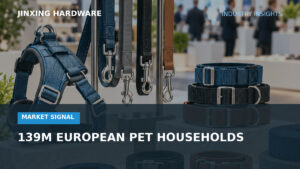
Dog ownership remains resilient in the United States, but the way
owners evaluate purchases is changing. According to the American Pet
Products Association’s preview of its 2026 Dog Report, 71 million U.S.
households owned a dog in 2025, up 4% year over year. At the same time,
buyers are becoming more budget-conscious and are looking for stronger
value in routine purchases.
For pet-product brands, distributors and sourcing teams, this does
not simply mean “lower price.” The more useful signal is that consumers
are protecting purchases connected to engagement, prevention and
functional daily care. Products used every day—leashes, collars,
harnesses, walking accessories and replacement hardware—therefore need
to combine dependable performance with an accessible price point.
Key takeaways
- Dog ownership reached 71 million U.S. households in 2025, according
to APPA’s preview. - Owners are optimizing routine purchases and favoring a mix of
competitive pricing and convenience. - Functional daily-care products remain more defensible than
discretionary accessories when budgets tighten. - Pet brands can compete through durable construction, clear
specifications and practical product architecture—not price alone.
Value is
becoming a product-design requirement
When buyers become more selective, weak points in product design
become more visible. A leash or harness may look attractive online, but
its hardware still has to perform through repeated opening, closing,
pulling, moisture exposure and abrasion. If a snap hook loses spring
tension, a D-ring deforms or a coating chips prematurely, the total cost
of ownership increases for both the consumer and the brand.
This changes the sourcing conversation. Rather than asking only for
the lowest unit price, successful buyers increasingly compare:
- Base material and load requirements
- Gate and spring consistency on snap hooks
- Weld quality and dimensional tolerance on rings
- Corrosion resistance for the intended environment
- Plating or coating adhesion
- Compatibility with webbing width and thickness
- Inspection standards and batch traceability
A well-specified component can reduce returns, negative reviews and
emergency reorders. Those savings are part of value, even when they are
not visible on the initial quotation.
Convenience starts upstream
APPA also notes the importance of convenience in dog-owner
purchasing. For product brands, convenience begins before the product
reaches retail. Consolidating compatible hooks, rings, buckles, sliders
and custom-logo parts with one manufacturing partner can simplify
sampling, quality control and shipment planning.
For example, a walking set may use a swivel snap hook, welded D-ring,
triglide slider and side-release buckle. When these parts are engineered
together, the brand can check fit, finish and color consistency as a
system instead of evaluating each component in isolation.
What pet-product
brands should review in 2026
- Separate essential performance from decorative
features. Protect the strength, fit and corrosion-resistance
requirements that affect daily use. - Create good-better-best specifications. Alternative
materials and finishes can serve different price points without changing
the entire product design. - Standardize shared components. Using the same
proven ring, slider or snap family across several SKUs can improve
purchasing efficiency. - Validate the complete assembly. Hardware should be
tested with the actual webbing, sewing pattern and product
geometry. - Plan replacement and repair options. Replaceable
components can extend product life and create useful after-sales
support.
A practical OEM opportunity
The market signal is encouraging for manufacturers and brands that
can translate “value” into measurable performance. Jinxing Hardware
supports custom metal hardware for pet, equestrian and webbing products,
including snap hooks, rings, buckles, sliders and application-specific
components. Material, size, surface finish, logo and packaging can be
developed around the target use and price segment.
The strongest 2026 product briefs will be specific: who uses the
product, where it is used, the expected load, the webbing dimensions and
the desired service life. Those details make it possible to engineer
cost effectively without compromising the features customers depend
on.
Frequently asked questions
Does value-focused sourcing always require a cheaper
material?
No. Value can come from standardizing dimensions, simplifying decorative
details, improving yield or selecting a more efficient finish while
keeping the performance-critical material unchanged.
What information should a buyer provide for a custom leash or
harness fitting?
Provide drawings or samples, webbing width and thickness, target load,
preferred material, finish, color, logo requirements, order quantity and
destination market.
Can several hardware parts be matched as one
collection?
Yes. A coordinated hardware family can be developed for consistent
color, finish, proportions and webbing compatibility across multiple
products.
Sources
- American
Pet Products Association, “2026 Dog Report Preview” - American
Pet Products Association, “Pet Industry Market Size, Trends &
Statistics”
Featured image: Photo by Andrew Spencer on Unsplash, used under
the Unsplash License. Image resized and cropped for this
article.
Ready to review a pet-hardware concept? Contact Jinxing Hardware for
an OEM/ODM specification discussion and quotation.