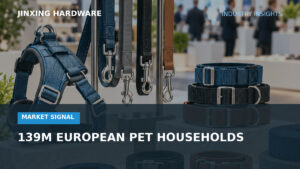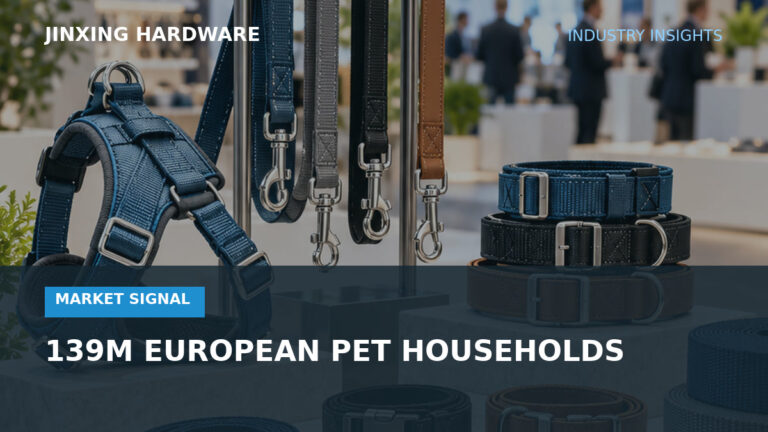
Europe’s pet market is large, but the sourcing opportunity is not
simply “more products.” FEDIAF’s 2025 Facts & Figures report, based
on the latest available 2023 data, counted 299 million pets in European
households and 139 million households owning at least one pet. It also
reported a pet-food market worth €29.3 billion and more than 400
companies operating 500 production facilities across Europe.
For pet accessory brands, distributors and OEM buyers, those numbers
point to a broad installed base of collars, leads, harnesses and
replacement components. They also highlight a market in which product
families, repeatable specifications and reliable replenishment matter
more than one isolated bestseller.
Key takeaways for hardware
buyers
- A large market needs coordinated product families. A brand may need
light, medium and heavy hardware that shares the same finish and visual
language. - Replacement and repeat orders reward specification control. Strap
width, internal dimensions, material, coating and approved samples
should be recorded as controlled data. - Premium appearance must be supported by repeatability. A polished
product image is not enough if finish shade, edge quality or spring
action changes between batches. - European sourcing increasingly connects product design with
documentation. Buyers should align physical hardware specifications with
product identification, packaging and safety information.
Build a
hardware family, not a collection of unrelated parts
The same collar or harness range may use several strap widths. If
every size uses an unrelated buckle or snap hook, purchasing, quality
control and replacement become harder. A better approach is to define a
hardware family around common rules.
| Design variable | Buyer decision | Why it matters |
|---|---|---|
| Webbing width | Define the usable internal width, not only the nominal size | Prevents loose fit, pinching and incorrect assembly |
| Product size | Light, medium and heavy series | Keeps weight and visual scale appropriate |
| Material | Zinc alloy, carbon steel or stainless steel | Affects cost, strength, corrosion behaviour and finish options |
| Surface finish | One approved colour standard across components | Reduces shade mismatch in a complete product |
| Moving parts | Spring force, gate clearance and swivel movement | Controls everyday usability and consistency |
| Identification | Part number, drawing revision and approved sample | Supports repeat orders and complaint investigation |
What buyers should send in an
RFQ
A useful RFQ should include the application, webbing width, material
preference, target finish, expected environment, target quantity and any
required tests. A drawing is ideal, but a dimensioned reference sample
can also work when the critical features are clearly identified.
For snap hooks, include the eye shape and usable eye width. For
buckles, state the strap path, tongue geometry and material thickness.
For rings and sliders, specify internal dimensions and whether the
component is welded.
What this means for OEM
development
The market data does not prove demand for any one buckle or hook. It
does show why buyers benefit from a modular sourcing system: fewer
uncontrolled variants, clearer testing requirements and easier
replenishment across product sizes.
Jinxing Hardware supports standard and custom hardware development
for pet collars, leashes, harnesses and webbing products. Projects can
be reviewed from drawings, dimensions or approved samples, with
material, size, finish, logo and packaging options defined before
production.
Frequently asked questions
How many European households own a pet?
FEDIAF’s 2025 report states that 139 million European households own at
least one pet, based on the latest available 2023 data.
Does market growth mean every pet accessory category will
grow equally?
No. Market totals describe the overall sector. Product-level demand
still depends on category, price point, country, channel and brand
positioning.
What is the first specification to confirm for pet
hardware?
Start with the application and the actual webbing width. Then define
material, internal dimensions, finish, load direction and inspection
requirements.
Sources
- FEDIAF, “FEDIAF Publishes 2025 Facts and Figures”: https://europeanpetfood.org/_/news/fediaf-publishes-2025-facts-and-figures/
- FEDIAF Statistics: https://europeanpetfood.org/about/statistics/
This article is general sourcing information, not a market forecast
or legal advice.