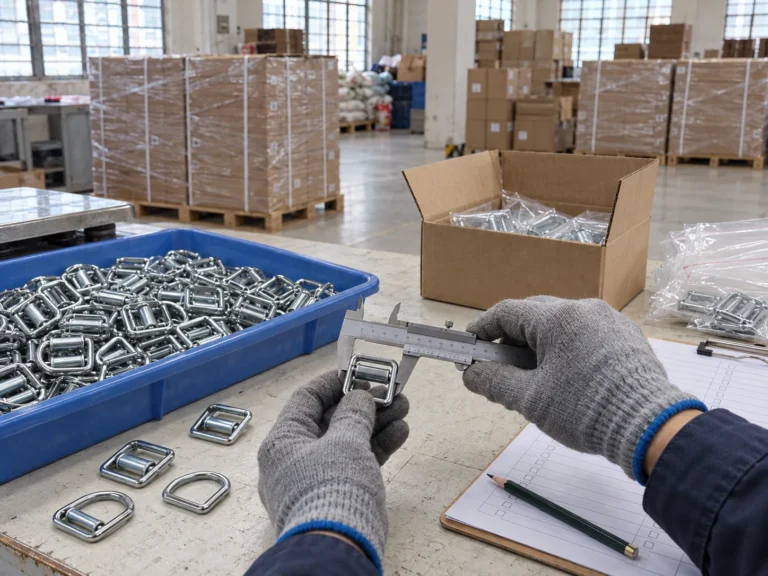
Quick answer: Traceability begins before any digital passport or compliance file is created. For metal hardware, buyers need a controlled chain connecting the product SKU to the correct drawing revision, material, finish, approved sample, inspection plan and production lot.
The EU Ecodesign for Sustainable Products Regulation establishes a framework for future product-specific rules and Digital Product Passports. It does not mean that every hook, ring or buckle already requires an individual passport. However, the direction is clear: brands and importers increasingly need structured product data that can be shared and verified across the supply chain.
What traceability means for a small metal component
A metal fitting may represent only a small share of product cost, but it can be a critical functional part. If a buyer cannot identify which drawing, material or finish was used, investigating a complaint becomes slow and uncertain.
A practical traceability record should answer: What is the part? Which revision was approved? What material and finish were ordered? Which lot was produced? What inspections were performed? Which finished products used the lot?
Seven records buyers should control
1. Part number and revision
Assign a stable part number and show the revision on drawings and purchase orders. Avoid using descriptions such as “same as last time” as the only specification.
2. Critical dimensions
Identify dimensions that affect fit and function: internal webbing width, wire diameter, opening, overall length, thickness and mating interfaces.
3. Material declaration
Record the agreed base material or material family. Where a precise grade is required, specify it before quotation and confirm what documentation is expected.
4. Finish specification
Define finish type, color reference, appearance standard and corrosion requirement. A color name alone is rarely enough for repeat production.
5. Approved sample or limit sample
Keep a signed or otherwise controlled reference for form, movement and appearance. Limit samples are particularly useful for minor plating marks or color variation.
6. Inspection and test records
Record measurement results, functional checks, appearance findings and any agreed corrosion or load tests. The test method, sample size and acceptance criteria should be stated.
7. Lot and packaging identification
Lot labels, carton markings and packing lists connect physical goods to production records and help contain issues without blocking unrelated stock.
A buyer-ready data package
- 2D drawing with revision and date
- Reference photos or 3D file where useful
- Material and finish requirements
- Approved sample record
- Inspection checklist and acceptance criteria
- Test reports requested by the buyer
- Lot code and shipment mapping
- Change log for tooling or process revisions
How to start without building a complex system
Begin with the highest-risk or highest-volume components. Create one naming rule, one drawing template and one inspection form. Require the same part number on the RFQ, purchase order, sample approval and inspection record. This small discipline creates a reliable data chain.
Jinxing Hardware can work from drawings or physical samples and support tooling, stamping, forming, finishing, inspection and packaging. Buyers should state documentation requirements during quotation because reports, sample sizes and third-party testing can affect cost and lead time.
FAQ
Does every metal fitting need an EU Digital Product Passport now?
No. ESPR is a framework, and requirements are introduced for prioritized product groups through specific rules. Buyers should verify obligations for their finished product and market.
What is the first traceability field to standardize?
Use a stable part number linked to a controlled drawing revision. That connection prevents many ordering and rework errors.
Can a physical sample replace a drawing?
A sample is useful, but a drawing is better for defining critical dimensions and revisions. For repeat production, use both when possible.
Sources and update note
Reviewed September 2026. Primary regulatory reference: European Commission — Ecodesign for Sustainable Products Regulation. This article is a supplier-readiness guide, not legal advice; product-specific obligations should be confirmed for the target market.