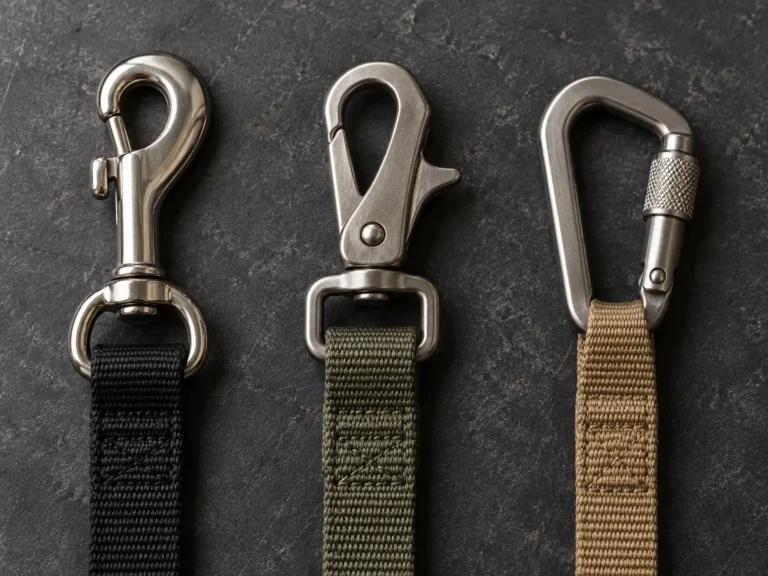
Bolt snaps, trigger snaps and carabiners can all connect a dog leash to a collar or harness, but they do not behave the same way. Their gate operation, webbing interface, weight, moving parts and manufacturing options create different tradeoffs for the user and the finished product.
This buyer’s comparison focuses on practical OEM selection. It does not assign a universal winner because the correct connector depends on the leash design, user behavior, environment and validated performance of the complete assembly.
Quick Answer
Choose a bolt snap for familiar one-handed use, a trigger snap when fast opening and webbing alignment are priorities, and a carabiner when a larger gate or locking option is required. The safest choice depends on the complete leash system, including webbing width, stitching, connector geometry, dog size, user operation and the buyer-defined test load.
Quick Comparison
| Connector | Typical advantage | Point to evaluate | Common product direction |
|---|---|---|---|
| Bolt snap | Familiar one-handed action and many size options | Slider return, nose closure and swivel joint | Everyday walking leashes and leads |
| Trigger snap | Wide lever and flat-webbing eye options | Lever exposure, gate clearance and webbing alignment | Flat webbing or fashion-led leash designs |
| Carabiner | Large opening and optional locking gate | Locking steps, bulk, orientation and cross-loading | Outdoor, technical or premium concepts |
1. Bolt Snap: Familiar and Versatile
A classic bolt snap uses a thumb-operated slider to retract the bolt or gate. Many versions include a round swivel eye, allowing the hook body to rotate relative to the leash. The design is familiar to many users and is available in a broad range of sizes, materials and finishes.
For evaluation, check whether the thumb piece is easy to reach, whether the spring returns the bolt completely and whether the nose closes without a visible gap. Dirt or dried salt can affect any moving mechanism, so include realistic contamination and cleaning conditions in the test plan when relevant.
The round eye is convenient for folded webbing and rope-style leads, but it allows more freedom of movement than a rectangular slot. Confirm that the webbing, stitching and eye radius work together without bunching or edge wear.
2. Trigger Snap: Fast Operation and Webbing Alignment
A trigger snap uses a larger lever to open the gate. It can be easy to operate and visually distinctive. Many designs include a rectangular or D-shaped swivel eye that suits flat webbing and helps present the strap neatly.
The lever position deserves careful review. It should be accessible to the user without being unnecessarily exposed to contact with the dog’s body, ground or surrounding objects. Check the gate opening against the actual collar or harness ring rather than a nominal diameter alone.
Because trigger snaps vary widely in geometry and construction, compare production samples rather than assuming all products with the same name perform alike.
3. Carabiner: Large Opening with Optional Locking
Carabiner-style connectors offer a large opening and can include a screw sleeve or other locking feature. This can suit outdoor and premium leash concepts, especially when the product story emphasizes deliberate connection and technical styling.
A lock adds an operating step. Test whether the intended customer can use it comfortably with gloves, cold hands or limited dexterity. Verify that the gate and locking sleeve remain functional after dirt, moisture and repeated cycling. The design should also control orientation: a carabiner loaded across the gate or at an unintended angle may not behave like one loaded along its intended axis.
Do not apply climbing-equipment assumptions or ratings to pet hardware unless the exact component is designed, tested and documented for that standard.
4. Compare the Webbing Connection
The connector’s eye is just as important as its gate. A round eye allows rotation and accommodates folded strap ends, while a rectangular eye can keep webbing flat. Measure the internal width, internal height, wire or frame thickness and contact radius.
- Use the finished production webbing, not only its nominal width.
- Check multilayer folds and seam allowances.
- Inspect edges and corners that contact fibers.
- Confirm that coating thickness does not reduce a critical opening.
- Test the complete sewn assembly under the intended pull direction.
For measurement terminology, see our hook, ring and slider size guide.
5. Weight and User Experience
Heavier is not automatically stronger, and lighter is not automatically more comfortable. A large connector can pull on a small dog’s collar, while an undersized gate can be difficult to clip to a thick harness ring. Compare weight, overall length, gate-opening clearance and hand feel together.
For each candidate, conduct simple use trials with the actual leash and mating ring. Observe one-handed operation, gate visibility, accidental contact, leash twist and how the connector hangs when the leash is slack.
6. Material and Finish Options
Stainless steel is often considered for wet and outdoor environments. Plated carbon steel can offer a strong cost-to-performance balance, while zinc-alloy components enable detailed shapes and decorative finishes. The application, geometry and qualified test result matter more than the material name alone.
For plated products, define the finish system, color reference, protected surfaces and corrosion test method. For stainless products, state the grade. Review our metal hardware surface finish guide when preparing the specification.
7. Build a Connector Test Plan
Component testing should reproduce intended use and foreseeable wear. A useful plan can include:
- Dimensional inspection against the approved drawing
- Gate-opening clearance with the actual mating ring
- Repeated gate and swivel cycling
- Visual inspection for burrs, cracks and incomplete finish
- Proof-load and destructive-load testing in a defined orientation
- Webbing abrasion and complete-assembly pull testing
- Corrosion testing with a named method and acceptance criteria
- Post-test function inspection
A test result is meaningful only when it identifies the sample, setup, direction, rate, duration and pass/fail rule. Follow our quality inspection checklist for batch-level controls.
8. A Practical Selection Process
- Define the leash type, user and environment.
- Measure the webbing and mating ring.
- Shortlist connector styles that meet the gate-opening and weight targets.
- Review material and finish options.
- Order production-representative samples.
- Conduct use, cycle, corrosion and load tests according to risk.
- Approve a drawing, sample and inspection standard before mass production.
Frequently Asked Questions
Which dog leash clip is most secure?
No connector type is universally the most secure. Security depends on geometry, material, gate design, condition, loading direction and the complete leash assembly. Compare validated products under the same defined test method.
Is a locking carabiner always better?
A lock can reduce some opening risks when used correctly, but it also adds size and an operating step. User behavior and orientation still matter.
Can I replace one clip style without retesting the leash?
Retesting is recommended whenever the connector, webbing interface, stitching pattern, material or finish changes, because these changes can affect the system rather than only the individual part.
Technical References and Testing Notes
- Connector testing: record the exact fixture, loading direction, loading rate, sample quantity and failure mode. Breaking load from one setup must not be treated as a universal working-load rating.
- Corrosion comparison: ISO 9227 and ASTM B117 provide laboratory salt-spray methods, but test hours do not predict a fixed number of months outdoors.
- System validation: test the finished leash with production webbing, stitching and hardware. Replacing one connector style changes geometry and requires renewed evaluation.
Technical review: Jinxing Hardware. Last updated September 22, 2026.
Source Dog Leash Hardware for Your Brand
Jinxing Hardware supplies hooks, rings, buckles and webbing hardware for pet-product manufacturers. Share your target connector type, webbing width, material, finish, quantity and test method through our custom hardware inquiry guide, then contact us for sampling and quotation.