Choosing a snap hook for a dog leash is not simply a matter of selecting a shape that looks right. The hook, eye, gate, material, finish, webbing and stitching work as one system. A reliable specification starts with the leash application and then confirms fit and performance with production-representative samples.
This guide explains how OEM buyers, pet brands and leash manufacturers can compare swivel-eye and fixed-eye hooks, select a compatible webbing slot, choose a material and build a practical test plan.
Quick Answer: Which Snap Hook Should You Choose?
| Design question | Common choice | Reason to verify |
|---|---|---|
| Leash tends to twist during walking | Swivel-eye snap | The rotating joint can help the leash align, but it adds a moving interface that must be tested. |
| Flat webbing should stay oriented | Fixed rectangular eye | A correctly sized slot can hold webbing flat and reduce rotation at the attachment point. |
| Wet or coastal use is expected | Suitable stainless grade or qualified protective finish | Base material, finish, cleaning and exposure all affect corrosion performance. |
| Low product weight is important | Compact hook sized to the real application | Weight, gate opening and strength need to be balanced rather than optimized separately. |
| Load-bearing performance is critical | Tested component and complete leash assembly | Appearance and nominal size do not establish a safe load rating. |
1. Start with the Leash Application
Begin by defining how the finished leash will be used. A lightweight city leash, a long training line and an outdoor working-dog lead expose hardware to different loads, movement, dirt and moisture. Record the intended dog-size range, leash length, webbing construction, attachment point and expected environment before selecting a hook.
Also consider how the user operates the gate. Gloves, cold weather, mud and frequent clipping can make a small or stiff trigger inconvenient. At the same time, an oversized hook may add unnecessary weight and change how the leash hangs.
2. Swivel Eye vs. Fixed Eye
Swivel-eye snap hooks
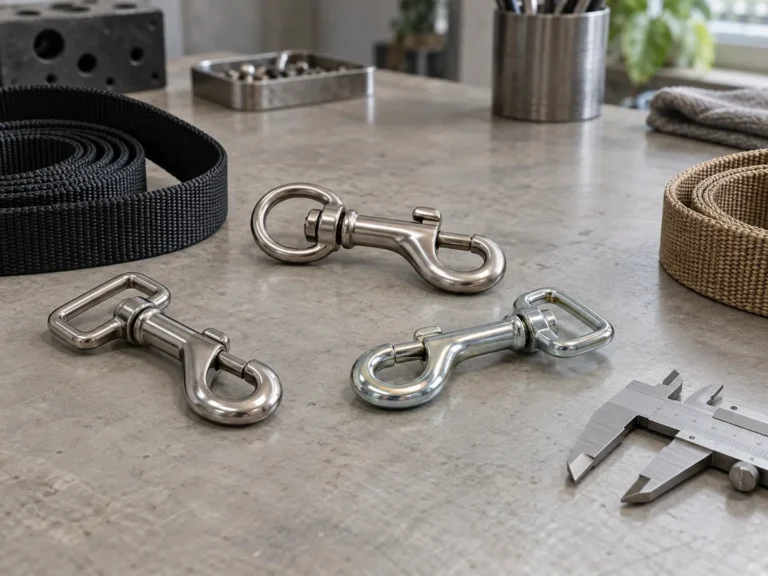
A swivel eye allows the hook body to rotate relative to the leash. This can help manage ordinary leash twist and gives the connection freedom to change direction. It is often chosen for walking leashes and tether-style products where the lead moves around the attachment point.
The swivel joint is also a mechanical interface. Buyers should inspect axial play, rotation smoothness, assembly security and performance after repeated movement. A swivel should not be treated as a substitute for correct leash handling or complete product testing.
Fixed-eye snap hooks
A fixed eye has no rotating joint. A rectangular eye can keep flat webbing aligned, which is useful when the brand wants the webbing face and printed pattern to maintain a consistent orientation. The simpler construction may also be attractive when compactness is the priority.
However, the leash can transfer twist directly to the hook. The design decision should therefore be based on the whole product, not on the hook alone.
3. Match the Eye to the Webbing
The internal eye width should match the finished webbing assembly. Measure the actual webbing width and thickness, including coating, folding and stitching. A slot that is too narrow can bunch or abrade the strap; a slot that is too wide may allow excessive side-to-side movement.
Round eyes are versatile for rope, folded strap ends and assemblies that need freedom to rotate. Rectangular eyes distribute flat webbing more evenly and can improve alignment. Check the radius of the contact surface and inspect for edges that could cut fibers.
Use the actual production webbing during sampling. Our metal hardware size guide explains the key dimensions to include on a drawing or inspection sheet.
4. Compare Base Materials and Surface Finishes
Common options include stainless steel, carbon steel with a protective finish, and zinc-alloy components. Each can suit a product when its grade, geometry, finish and test requirement are clearly defined.
- Stainless steel: often selected for wet or outdoor exposure. Specify the grade instead of using the word stainless as a complete requirement.
- Plated carbon steel: can provide a practical balance of cost, strength and appearance. Corrosion behavior depends on coating system, thickness, coverage and wear.
- Zinc alloy: supports complex shapes and decorative finishes. The part design and application load must be evaluated for the final use.
Black, antique, nickel-color and other finishes should be approved against a physical sample or controlled reference. See our surface finish guide before finalizing color and corrosion requirements.
5. Evaluate the Gate and Hook Geometry
Check that the gate opens far enough for the intended D-ring or collar ring. The user should be able to operate it consistently, while the spring should return the gate to a fully closed position. Inspect the nose and gate interface for visible gaps, interference and sharp edges.
Gate feel alone does not establish security. Include repeated opening and closing, contamination exposure and pull tests in the validation plan when those conditions are relevant. Test the hook in the same direction it will be loaded in the finished leash.
6. Do Not Select by Size Alone
Overall length and webbing-eye width are useful purchasing dimensions, but they do not determine load capacity. Two hooks of similar size can use different materials, cross-sections, heat treatments, rivets and assembly methods.
If a load requirement matters, define the mounting method, pull direction, test speed, hold time, permitted deformation and failure criterion. Request results for the actual version being purchased. Never assign a working load by applying a generic rule to product weight or nominal size.
7. Test the Complete Leash System
A strong hook cannot compensate for weak stitching, unsuitable webbing or an undersized ring. Validate both the component and the finished assembly.
- Verify dimensions against the current drawing.
- Inspect burrs, sharp edges, cracks and finish defects.
- Check gate opening, closure and spring return.
- Cycle the gate and swivel when repeated use is expected.
- Test webbing fit and inspect for cutting or bunching.
- Apply the agreed proof or destructive load method.
- Evaluate corrosion with a defined standard and acceptance criterion when required.
- Retest the complete leash after any material, geometry or finish change.
Use our metal hardware quality inspection checklist to organize incoming or pre-shipment checks.
8. What to Include in an RFQ
Send a drawing or approved sample together with the intended application. Include overall dimensions, eye type and internal width, gate opening, base material, surface finish, color reference, order quantity, packaging and testing requirements. Identify any dimensions that affect the webbing or mating ring as critical.
For a custom design, provide a 2D drawing and 3D file when available. Our guide to preparing a custom metal hardware inquiry lists the information that helps a factory quote accurately.
Frequently Asked Questions
Is a swivel snap always better for a dog leash?
No. A swivel can help manage twist, but a fixed rectangular eye may be preferable when flat-webbing alignment, compactness or a simpler construction is more important.
What size snap hook should I use?
Select the size after checking the dog-leash application, webbing width and thickness, mating ring, gate opening, product weight and validated performance. There is no universal size-to-dog-weight conversion.
Can a salt-spray result predict outdoor service life?
Not directly. A controlled corrosion test is useful for comparison and qualification, but real service life also depends on wear, cleaning, chemicals, moisture cycles and product design.
Technical References and Buyer Test Notes
- Fit verification: confirm eye width, webbing thickness, gate clearance and swivel movement with production-representative samples.
- Load validation: define fixture, loading direction, sample quantity, static or cyclic method and acceptance limit. Size alone does not establish safe working load.
- Corrosion comparison: ISO 9227 and ASTM B117 can support controlled salt-spray comparisons, but test hours must not be presented as guaranteed outdoor life.
Technical review: Jinxing Hardware. Last updated September 22, 2026.
Need an OEM Snap Hook Recommendation?
Jinxing Hardware manufactures metal hooks, buckles, rings and sliders for webbing-based products. Send us your leash webbing width, target finish, application, quantity and test requirements. We can review standard options or evaluate a custom part through our manufacturing capabilities. Contact us to discuss your project.